Pupillary distance (PD) is the measurement in millimeters between the centers of your pupils. It helps ensure your eyes align with the optical center of your lenses for the best clarity. If it’s not on your prescription, you can measure it yourself with our downloadable PD ruler and easy step-by-step guide.
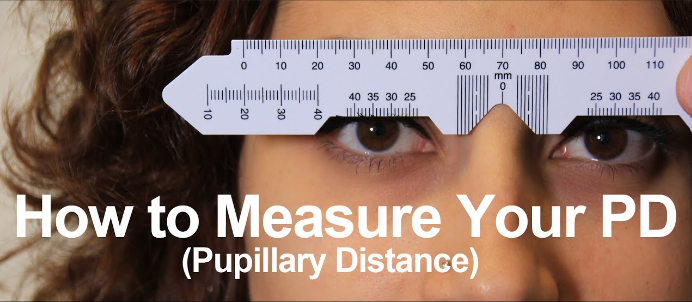
To measure PD using a PD ruler, have the person sit comfortably and focus on an object 10 to 20 feet away to keep their eyes steady. Place the PD ruler against their forehead and align the “0” mark with the center of their right pupil. The number above the center of their left pupil is their PD. Closing one eye while reading the measurement can help ensure accuracy. This will give you the correct PD for ordering your glasses.
Measuring your pupillary distance on your own is easy with a PD ruler and a mirror. Here’s how to do it:
It’s a good idea to relax and remeasure a few times to ensure you get the most accurate PD. If you get different results, calculate the average by adding up the numbers and dividing by the number of measurements you took. This will give you your final PD.
For progressive or bifocal lenses, you’ll also need to measure your near focus PD, which requires a second person to get an accurate reading. The person measuring should follow the same process as for your regular PD, but instead of focusing on a distant object, you should focus on a pen held between you and the measurer. While you do this, they can read and record your near focus PD.
Your PD is essential to ensure that the center of your lenses aligns with your pupils, especially if you have high-powered lenses. It might be included on your vision prescription, usually as a single number, like 64. If your prescription shows a difference between the bridge of your nose and each eye, it could be listed as two numbers, such as 32 and 31. These represent the PD for each eye separately. If your PD isn’t listed on your prescription, you can measure it at home using a ruler or have it measured by an eye care professional.
The average PD for women typically ranges around 60 mm, while for men, it averages about 64 mm. However, the pupillary distance can vary for each individual, with typical measurements falling between 48 mm and 73 mm. It’s important to measure your own PD for the most accurate fit.
Single PD measures the distance from the center of one pupil to the center of the other. Dual PD, on the other hand, is the distance from each pupil’s center to the middle of the nose. In a dual PD measurement, the number for the right eye appears first, followed by the left eye’s PD.
In addition to the various mobile apps that can measure PD using your phone’s camera, Bonnieview has a tool that can do this. When entering your glasses prescription, simply press the ‘i’ button in the PD section.
In addition to the various mobile apps that can measure PD using your phone’s camera, Eyebuydirect has a tool that can do this. When entering your glasses prescription, simply press the ‘i’ button in the PD section.
You won’t usually find your PD written (or etched) on your glasses. The numbers you see inside your frame’s arms are the measurements for the frame itself, but not your personal pupillary distance. An eye care professional should provide a PD number on your vision prescription in the corresponding section.
Your PD should be exact. If your lenses aren’t centered correctly, wearing them may be uncomfortable. A small margin of error may not cause problems, but it’s better to be as accurate as possible.
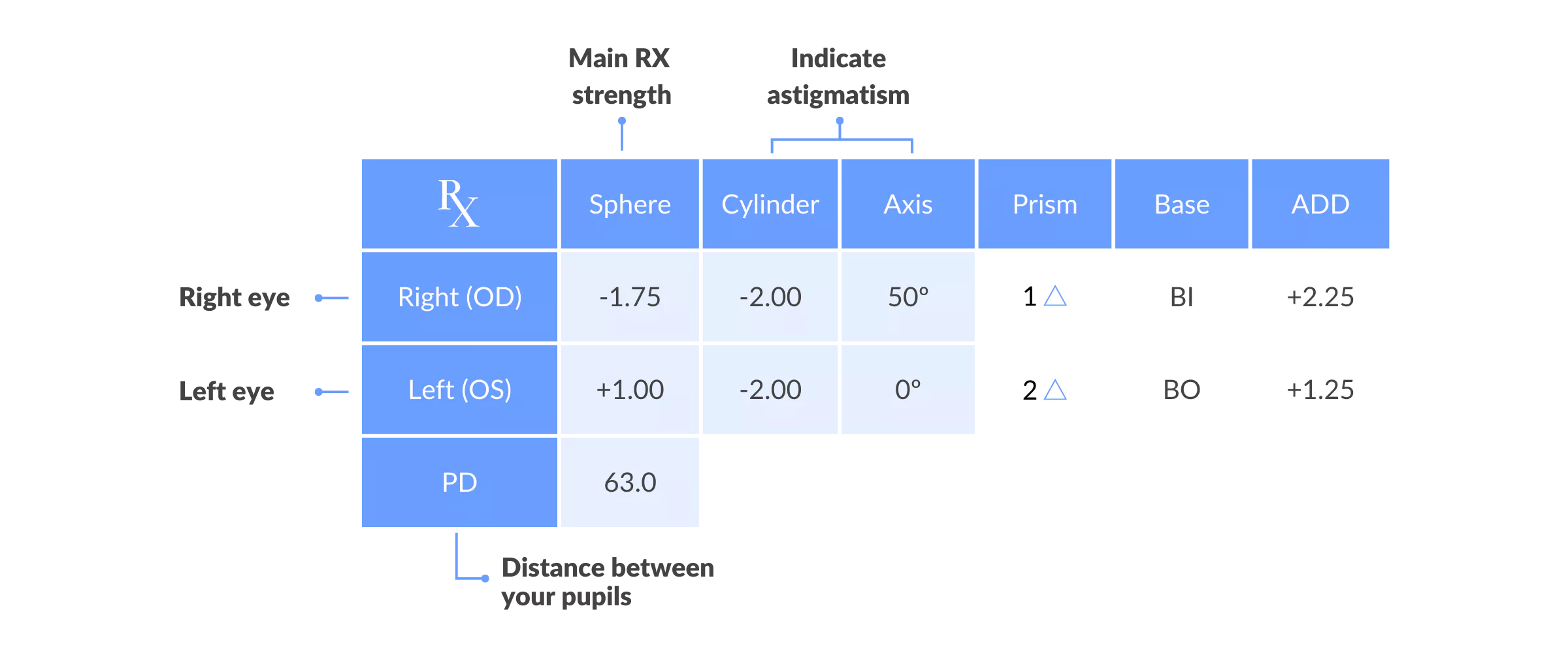
Your PD will be in the ‘PD’ or ‘pupillary distance’ section of your prescription. This is often separate from the ‘grid’ section of your prescription, where the doctor writes out the main prescription information.
Your vision is centered on a small section of your lenses, and the PD is used to shape the lenses to accommodate this. If your lenses aren’t properly centered based on your pupillary distance, they can cause dizziness, headaches, and/or blurred vision.
Your pupillary distance influences the shape of your lenses, but it has no effect on the size of your frames.
A person’s pupillary distance will change when they are young as they are still physically growing. Once they reach maturity and stop growing, their pupillary distance will change very little, if at all.
Your pupillary distance indicates exactly which part of the lens you look through; therefore, the PD measurement is important for every type of prescription, including glasses with single-vision lenses.
A ‘single’ pupillary distance number is the distance in millimeters between one eye’s pupil to the other eye’s pupil. A ‘dual’ pupillary distance number is the distance in millimeters from each eye’s pupil to the center of your nose. A single PD will be just one number, while a dual PD will have a number for each eye, marked ‘right’ and ‘left’. (Some prescriptions may have ‘OD’ for the ‘right’ eye, and ‘OS’ for ‘left’ eye.)
You can find out your pupillary distance by either measuring yourself or asking a friend to do it for you. If you’re doing it yourself you’ll need a mirror and you’ll need a ruler regardless. Download our printable ruler or use your own. Just follow the steps on the page above and you’re good to go!
Knowing your PD is important for your glasses because knowing your measurements will help you choose the right size. That means you’ll be looking through the exact center of your lens once you know it and your vision will be crystal clear.
Your PD is important for all prescription eyewear because your eyes should be looking through the exact center of your corrective lenses. However, pupillary distance is not necessary if you’re ordering non-prescription sunglasses.
The average pupillary distance is somewhere between 48mm and 73 mm. However, everyone’s eyes are different and your PD might be different from the average person’s.
We can make lenses that include a prism. All prescription orders are verified by one of our opticians. If your written prescription has a prism, we will confirm with you before crafting your custom lenses. There will be a slight upcharge for adding a prism to your prescription.
FRAME WIDTH
FRAME WIDTH
*Suggested age